

Strategic Realignment
Lunar New Year pushed this report back a few weeks. Turns out the delay was lucky. Watching January unfold in the rearview mirror made things clearer. That tax return hit at exactly the right time. It gave me enough runway to restructure before the Warsh news dropped and Bitcoin cratered.
🌐 Market Update
January was a month of 2 distinct halves. The first, a euphoric climb to psychological levels, and the second, a cold-water reality check.
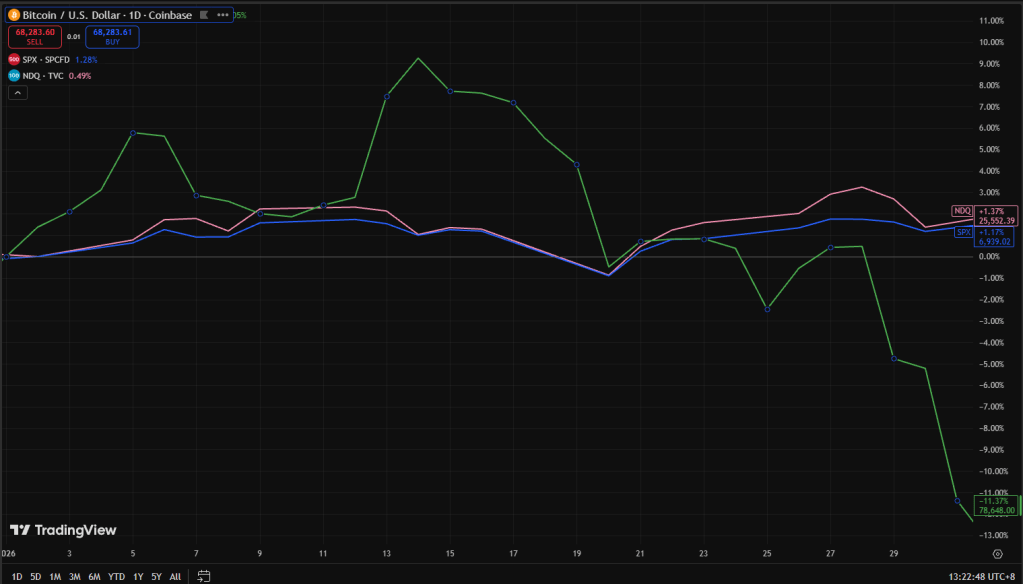
The S&P delivered modest but significant gains, breaching the historical peak of 7,002 (+1.8%) in mid January. While it did not sustain the level closing the month at 6,939 (+1.17%). It set the tone for the year. Historically, a green January carries a high probability of a positive full year.
Beneath the surface, while tech remained the anchor, we also saw the first structural rotation into commodities and international Small-Caps. This rotation was also mirrored in our own portfolio as we started shifting away from the initial Yield-Engine.
Bitcoin was a violent V-top. It climbed to 97,861 (+11.2%) by mid month, teasing the 6 figure mark, but then swiftly fell to 78,648 (-11.37%) as we approached the end of the month.
The main cause of this was the nomination of Kevin Warsh as the next Federal Reserve Chief. Upon seeing the tweet from President Trump, followed by the official nomination, markets immediately repriced for a “Hawkish” 2026. Bitcoin plummeted a staggering 19.6%. This drop was 6% from the mid month peak. It further confirmed that the Yield Strategies were no longer a reliable source of income. They were providing capital destruction.
That said, while Bitcoin bled, commodities and semiconductors came into the spotlight. Gold and Copper showed resilience during the Warsh announcement prompting our new commodities pillar. Semiconductor firms such as Nvdia and AMD earnings mid month also confirmed that the AI buildout wasn’t slowing down. We decided to use the tax returns from the YieldMax funds to further build this layer.
🖋️ Opening Thoughts: A Lesson in Conviction
While month 15 was a lesson in humility, month 16 was about taking action from that lesson. The “Warsh Shock” sent the crypto crowd into a panic with a wave of liquidations and flash crashes. However, my Lunar New Year break was surprisingly calm.
The tax return changed everything. $4,985 hit the account right when I needed it. I’d been patching leaks in the Yield Engine for months. Those crypto-proxy funds were just bleeding. January was when I stopped trying to fix it and started rebuilding from scratch.
Commodities pillar established. Semiconductors doubled. The portfolio went from tracking inflation to actually positioned for it. The 4.1% organic growth after months of treading water? That’s what matters.
📊 NAV Progression
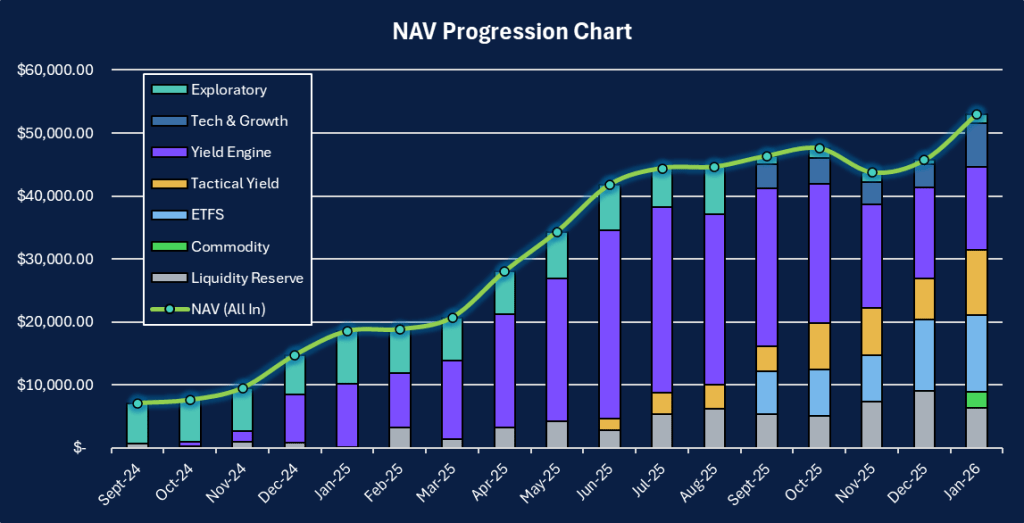
Portfolio closed at $52,983. Finally broke through $50k.
Total inflow: $5,410 (dominated by the tax return). Organic returns: $1,890. Way better than the broader market.
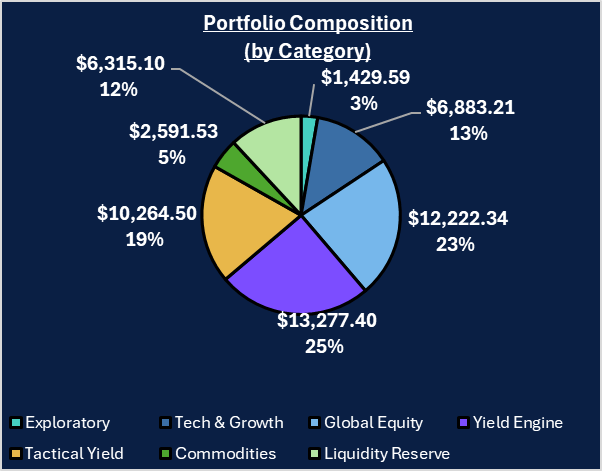
I dropped cash reserves to 11.9% ($6,315) to fund the commodity and semiconductor positions.”
🔑Key Takeaways
- The New Pillar: Commodities
Started the commodities position at $2,591 across GLD, CPER, and SLV. When paper assets wobbled during the Warsh announcement, these held steady. - Tactical Yield: The SOFI engine
SOFI surged 56.8% to $10,264. Got assigned on puts, which forced me to scale up the position. Generated $221 in options premium managing it. - Tech & Growth: The Infrastructure Bet
Expanded the infrastructure bets. NVDA up to $2,866 (+53.7%), opened a new $2,367 position in AMD.
🧩Portfolio Updates
Yield Engine (MSTY, CONY, ULTY)
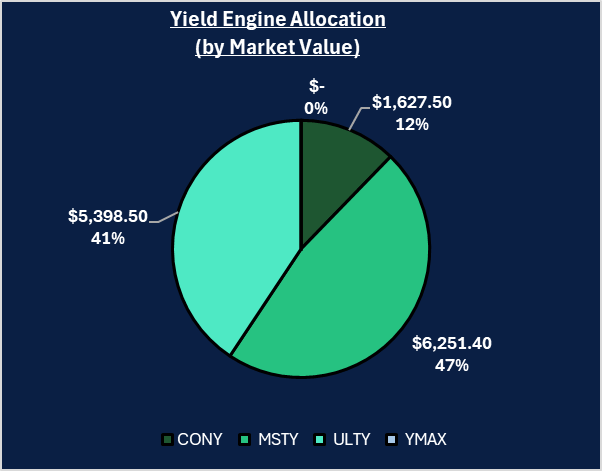
The Yield Engine closed at $13,277, down $1,098 or 7.6%.
| Ticker | End Value | Change | Post-Split Shares | Dividends |
| MSTY | $6,251.40 | -8.2% | 230 | $ 321.90 |
| CONY | $1,627.50 | -17.3% | 50 | $ 61.98 |
| ULTY | $5,398.50 | -3.6% | 150 | $ 260.74 |
| Total | $13,277.40 | -7.6% | $ 644.62 |
The sleeve represents 25.1% of the portfolio, and no longer adding to it.
ETFs (CSPX, IWDA, VWRA, WSML)
Grew to $12,222 (+7.5%), now 23.7% of NAV. Closed IWDA due to overlap, opened WSML for small-cap exposure.
| Ticker | End Value | Change | Notes |
| VWRA | $4,367.50 | -5.5% | |
| CSPX | $5,946.24 | +15.0% | Outstanding performance |
| WSML | $1,908.60 | +100.0% | Opening position of $1,908.60 |
| IWDA | $0.0 | -100.0% | Closing of position |
| Total | $12,222.34 | +7.5% |
Tactical Yield (SOFI)
SOFI closed at $10,265, up $3,720 or 56.8% mainly due to assigned shares. Option activity generated $222 through selective put sales and call management. Premiums compressed as volatility faded into year-end.
Tech & Growth
This sleeve rose 86.0% to $6,883, representing 13.0% of NAV. Mainly attributable to an increased stake in Nvdia (NVDA) and Advanced Micro Devices (AMD)
Exploratory Footprint
A further 2000 share position was opened for Infinity Dev. increasing this sleeve by 116.9%, representing 2.7% of NAV.
Liquidity Reserves
Cash reserves dropped to $6,315, or 11.9% of NAV. The reserve was used to fund the new Commodities pillar and new positions in NVDA, AMD and 640.
🎯Objective Review
January was a pivotal month where strategic reallocation took precedence over raw income generation. Here’s how the portfolio performed against the goals set in December:
Base Goals
Income Goal: Generate at least $1,000
Status: ❌ Missed
Actual: $866.50
Dividends were $645 (MSTY, ULTY, CONY), options added $222 through SOFI.
Deploy capital to reach ~15 – 17% liquidity
Status: ✅ Achieved
Actual: 11.92%
Actually went lower. Pushed hard into commodities and semiconductors.
Maintain SOFI Collars
Status: ✅ Executed
Couldn’t hit my 2.5% rule with volatility this low and the premiums compressed.
Stretch Goals
Income Above $1,250
Status: ❌ Missed
Actual income was $866.50, significantly short of the stretch target as the Yield Engine was intentionally de-emphasized.
Organic Growth of $2,000+
Status: ⚠️ Almost Achieved
Organic returns grew by $1,890, narrowly missing the target due to the late-month “Warsh Shock” volatility.
Build ETF Sleeve to $15,000
Status: ❌ Condition Not Met
The ETF sleeve was increased to $12,222. However, $2,592 was diverted into the newly established Commodity Pillar to prioritize non-correlated diversification over broad index exposure.
Scorecard Summary
January was a transitional success despite missing the income target. The sudden drop in Bitcoin and the broader “Warsh Shock” forced a strategic retreat from legacy yield engines. By deploying liquidity into Commodities and Semiconductors, the portfolio successfully traded short-term yield for long-term structural resilience.
📁Transactions
December Transactions
Semiconductors: AMD & NVDA
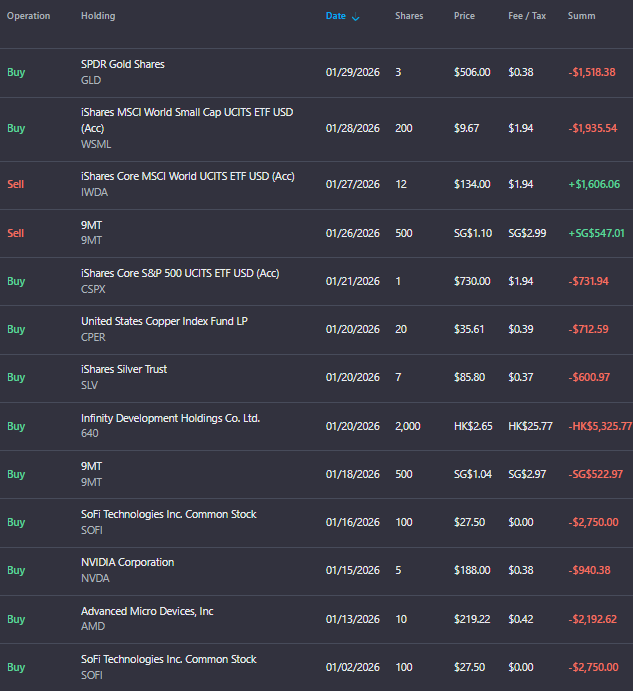
On 13-Jan-2026, the portfolio established a major new tactical anchor with the purchase of 10 shares of AMD at $219.22. This was followed on 15-Jan-2026 by an additional 5 shares of NVDA at $188.00. These deployments, funded largely by the tax return, significantly increased our exposure to AI infrastructure during a period of high mid-month momentum.
The Commodity Pillar (GLD, SLV, CPER)
To hedge against fiscal volatility, the portfolio initiated a new structural pillar between 20-Jan-2026 and 29-Jan-2026. This included the purchase of 20 shares of CPER at $35.61, 7 shares of SLV at $85.80, and 3 shares of GLD at $506.00. This gave me a hedge when Bitcoin started dropping.
ETF Sleeve: WSML & IWDA
The ETF sleeve underwent a significant quality tilt late in the month. On 27-Jan-2026, the portfolio fully liquidated its IWDA position, selling 12 shares at $134.00. The proceeds were immediately rotated on 28-Jan-2026into a new opening position of 200 shares in WSML (Small-Cap Value) at $9.67.
Tactical Yield: SOFI
SOFI saw aggressive activity throughout the month, primarily driven by the assignment of short puts. Major entries included 100 shares at $27.50 on 02-Jan-2026 and an additional 100 shares at the same price on 16-Jan-2026. These assignments effectively forced a scale-up of the position, which ended the month as a top contributor to total NAV.
SOFI Options
Option activity on SOFI generated $221.88 in net income through 5 put / call sales:
| Transact | Strike | Type | Capital @ Risk | Contracts | Premium (Net) | Premium % | Expiry |
|---|---|---|---|---|---|---|---|
| 5-Jan | 27.50 | Sell Put | $2,750 | 1 | $40.86 | 1.49% | Assign |
| 5-Jan | 31.00 | Sell Call | $6,200 | 2 | $89.27 | 1.44% | Closed |
| 13-Jan | 25.00 | Sell Put | $2,500 | 1 | -$97.90 | -3.92% | Closed |
| 15-Jan | 30.00 | Sell Call | $9,000 | 3 | $115.41 | 1.28% | Closed |
| 30-Jan | 22.50 | Sell Put | $2,250 | 1 | $74.24 | 3.30% | Open |
| Total | $8,050 | 8 | $211 | 0.72% |
January option activity achieved a 0.72% net premium relative to capital at risk, below the 2.5% monthly target. This was mainly due to a decision to close the $25.00 Sell Put to avoid assignment.
🔭 Next Steps
The portfolio has successfully navigated the initial “Warsh Shock,” but the road ahead requires tactical discipline to protect our new $52,983.67 NAV.
- Defensive Shield Maintenance
Holding $6,315 cash (11.9%). Not touching it until I’m sure the Fed’s hawkish stance is fully priced in. Bitcoin’s sitting at $78k. I want to see if that floor holds. - Commodity Pillar Optimization
Watching the commodity positions. If the dollar weakens in March, I’ll push this from 4.9% to 7.5% of the portfolio. - Reduce Liquidity to 15-17%
The 19.8% cash position is defensively appropriate given December’s conditions, but it’s too high for productive capital deployment. The target is to bring liquidity down to 15-17% through a combination of earned income and strategic ETF purchases. - Tactical Yield & Option Management
SOFI is now a major position at $10,264. Focus shifts to premium harvesting. Selling OTM calls to make up the $133 income gap from January.
📅 Month 17 Objectives
✅ Base Target
- Protect the $50,000 NAV Floor
Maintain the portfolio’s total value above the newly breached psychological ceiling despite the ongoing volatility in Bitcoin and high-beta tech. - Income Recovery: Target at least $1,000
Restore monthly cash generation to at least $1,000 after January’s normalized result of $866.50. - Maintain 10–12% Liquidity Reserve
Hold our $6,315 cash buffer to ensure we have “dry powder” for any systemic dips below the $78,648 Bitcoin support level.
🚀 Stretch Goal
- Expand the Commodity Pillar to 7.5% of NAV
Currently, the GLD, SLV, and CPER positions represent roughly 4.9% of the portfolio ($2,591). We aim to increase this to $4,000 if precious metals show resilience against a strengthening dollar. - Organic NAV Growth of at least 2.0%
Achieve a minimum of $1,000 in organic growth. This would confirm that our “Infrastructure” bet (Semiconductors) can continue to carry the portfolio’s performance even as the broader market consolidates. - Generate $300+ in Net Options Premium
Leverage the heightened volatility in SOFI following its 56.8% surge to harvest premium through defensive collars and cash-secured puts.
Risk Management
Primary Rule:
As we move into February (Month 17), our Risk Management protocols must evolve to reflect the “Warsh Shock” and the new reality of a hawkish Federal Reserve. While the $50,000 NAV milestone has been breached, the Primary Rule remains: capital preservation takes priority over income generation.
🧠 Final Thoughts
The Lunar New Year delay gave me time to see January clearly. The ‘Warsh Shock’ exposed how fragile those yield engines were. When Bitcoin dropped from $98k to $78k, I was glad I’d already moved that tax return into commodities and semiconductors.
Missing the $1,000 income target stings, but the 4.1% organic growth during that crypto chaos? That’s the real win. The portfolio isn’t just a number anymore. it’s built to handle what’s coming.
Sitting at $52,983 with $6,315 in cash. The goal now is sustainability, not just growth. Defend the floor, collect the rent, stay disciplined.
💬 Let’s Talk
Bitcoin at $78k still makes me nervous, but at least the gold is holding. Anyone else bail on the high-yield crypto stuff, or are you still riding it out?
 Equity-Pulse
Leave a comment