
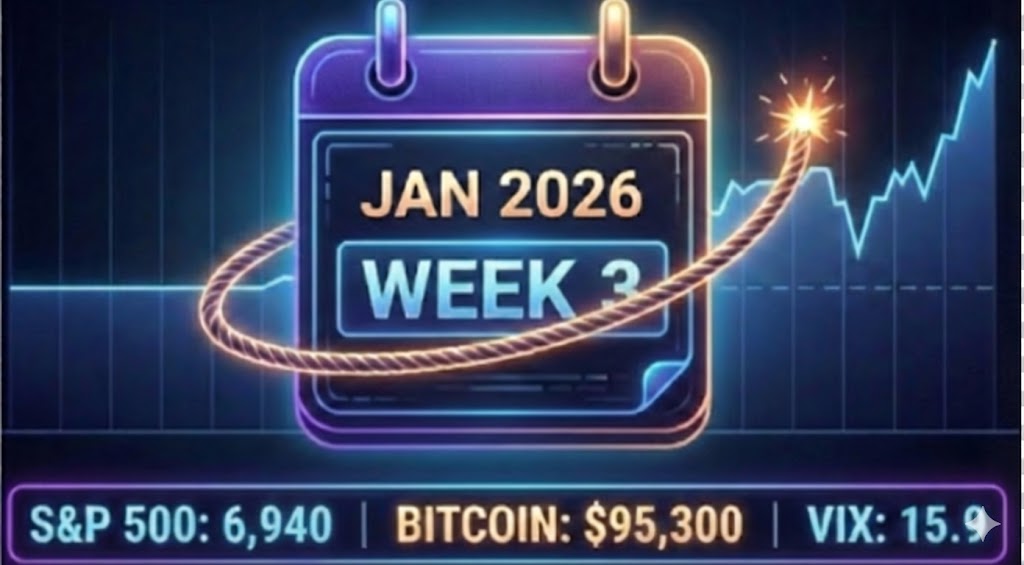
14 Jan 2025 – 18 Jan 2026
Week 3 Market Analysis
The Standoff • January 13, 2026
|
📈 S&P 500
6,940
↓ 0.5% Profit Take
|
₿ BITCOIN
$95,300
↑ 4.5% Breakout Confirmed
|
📊 VIX
15.9
→ Growing Policy Uncertainty
|
|
S&P RESISTANCE
7,000
|
S&P SUPPORT
6,850
|
|
|
BTC RESISTANCE
$97,000
|
BTC SUPPORT
$93,000
|
|
CPI lower than expected • Bank earnings beat estimates
• Trump’s credit card rate cap rattles financials
CPI Delivers, Market Doesn’t Care
Tuesday’s CPI report brought some relief. Core inflation rose 0.2% in December, the same as in November, and overall prices increased by 0.3%. Inflation is slowing but still above the Fed’s target. Annual headline inflation was 2.7%. Shelter costs went up 0.4%. Other categories changed in different ways.
Lower inflation often sparks hopes of rate cuts, but this week, markets were unmoved by high stock valuations, with the S&P 500 Shiller CAPE ratio at 40.32. Instead, investors shifted attention to political and policy news, highlighting the influence of upcoming Federal Reserve decisions and political statements. This shift set the stage for how markets responded to the week’s remaining developments.
Fox Business reported that Trump posted on Truth Social, urging Jerome Powell to cut interest rates “MEANINGFULLY” after the lower inflation numbers. Still, these numbers did not lead to any immediate change in the Federal Reserve’s policy. The S&P 500 fell by 0.5%, closing at 6,940.01 as investors waited for the Fed’s next rate decision. With these policy uncertainties, attention then turned to how markets would react to corporate earnings and sector-specific moves.
Equities: Why Good Earnings Weren’t Enough
Despite record earnings, the S&P 500 could not move above 7,000, showing slowing momentum. Volume was low, and investor confidence dropped. Bank stocks like Wells Fargo fell despite strong fourth-quarter results across most banks.
On Friday, Trump proposed a one-year cap on credit card interest rates at 10%, pushing financial stocks lower. JPMorgan’s CFO warned that this cap could harm consumers. In early trading, Citigroup dropped 3.7 percent, JPMorgan fell 2.5 percent, and Bank of America was down 1.6 percent. Wells Fargo, Bank of America, Citi, and JPMorgan also experienced declines later, with falls of 4.6%, 3.8%, 3.3%, and 1%, respectively. Meanwhile, the Russell 2000 rose alongside oil companies, while major U.S. indexes slipped from earlier highs amid pressure on banks and tech stocks. Despite this, key indexes closed slightly higher on Monday, January 12, 2026, reaching new record highs. Investors should remain alert for volatility from policy headlines and sector moves, which could impact returns even in record-setting weeks. These market crosscurrents contributed to renewed interest in alternative assets, such as Bitcoin.
Bitcoin: Finally Breaking Out
Bitcoin moved above $95,000 and nearly reached $97,000, but pulled back to $95,300 by the end of the week. Even so, that’s a solid 4.5% gain from last week’s $91,200 close. More importantly, BTC reclaimed the key $95k resistance level that has been stopping rallies since December.
Trading volume increased, and institutional buying continued. Bitcoin is acting more like digital gold again, rather than a risk-on tech stock.
$95k held as support several times this week. If BTC closes above $95,938, the next target is $100k; support stands at $93k, with downside to $90–92k possible. Investors should note these levels when planning entries or exits, as volatility can shift market momentum quickly.
The setup looks better than in recent weeks. Momentum has shifted, and accumulation continues. The current strategy is to keep buying, but watch for bigger risks, such as Trump’s tariffs or Fed uncertainty, which could interrupt the rally.
Volatility: No Fear Yet
The VIX closed at 15.9, up from last week’s 15.0, which is a notable increase given the current political uncertainty. For investors, this low volatility is unusual, especially with political issues, falling bank stocks, and stocks pulling back from record highs. Low-volatility periods like this can limit returns for option sellers using covered calls, since option premiums stay low. In Iran, a new 25% tariff on top of existing rates for its trading partners took effect immediately, and more executive actions are expected. Markets are still unsure how to react, underscoring the importance of central bank independence and leadership.
The Powell investigation and Trump’s calls for cuts are raising market tension. Investors should watch for potential changes in Fed leadership that could increase market uncertainty. Tech sector results next week will test whether the market breaks above 7,000. For Bitcoin, the $94,500 to $96,000 range could determine a push toward $100,000. Given high expectations, there is an increased risk of disappointment.
The Week Ahead
Trump Policy Volatility
The credit card rate cap is only the beginning. Iran tariffs are already in effect, and more executive actions are likely. Markets are still trying to figure out how to respond.
Fed Independence Under Threat
The investigation into Powell is ongoing. Trump is pushing for rate cuts, but Powell will wait for the data before making a move. If Powell is removed or Trump appoints a new Chair in May who quickly cuts rates, the Fed will lose its independence. Markets will be left uncertain.
Earnings Continue
Goldman, Morgan Stanley, and BlackRock reported their earnings on Thursday. Next week, Netflix is among the companies scheduled to announce their earnings, and these results will help indicate whether the market can continue to climb or if 7,000 marks the recent high.
Bitcoin at Critical Level
$95,000 is the key level. If Bitcoin moves above $97,000, momentum will pick up. If it falls below $93,000, the rally could end.
Markets received a softer CPI report. Banks posted strong earnings, and Bitcoin broke through resistance. Still, the S&P pulled back from its highs. This shows how current sentiment is:
Markets are priced for perfection and are at risk of disappointment.
 Equity-Pulse
Leave a comment